How to Ask the I Ching a Good Question
The question shapes everything you can learn from a reading. Here is how to frame open, honest questions the Book of Changes can actually answer — with examples to copy.
People often blame the oracle when a reading feels vague. Far more often, the problem is the question. The I Ching does not answer like a search engine. It answers like a wise friend who listens to how you ask, and then describes the situation you are standing in. A muddy question gets a reading that is hard to hold; a clear one gets a reading you can use.
This guide walks through what makes a good question, the most common mistakes, and a simple routine you can follow before every cast.
Why the question matters so much
Each hexagram describes a kind of situation — waiting, conflict, a fresh start, a gradual decline — together with the attitude that tends to fit it. The text is deliberately general: Hexagram 5, Waiting, could speak about a job offer, a pregnancy or a delayed train. Your question is what tells you which situation the image is a picture of.
That is why the classical commentaries stress sincerity. The point is not that the coins "know" your intention. The point is that a sincere, focused question makes you a better reader of the answer.
Five qualities of a good question
1. It is about your own situation
"What should I understand about my role in this project?" works. "Will my colleague get fired?" asks the book to report on someone else's life, and leaves you with nothing to do. Even when another person is central, frame the question around your part: How can I support my sister through this?
2. It is open, not yes-or-no
The I Ching rarely says "yes" or "no". Its judgments say things like perseverance furthers, no blame, or misfortune if you persist. These are conditional: they describe what tends to happen under a certain attitude. Open questions fit that grammar.
Useful openings:
- What should I understand about…?
- What attitude will help me with…?
- What is the nature of…?
- What happens if I choose to…?
3. It is specific enough to recognise
"What about my life?" is too wide to read. "What should I understand about the next six months at my new job?" gives the hexagram something to attach to. Naming a time frame often helps.
4. It holds one question, not three
"Should I move to Lisbon, and will I find work, and is my relationship strong enough?" is three readings. If you cast once for all of them, you will unconsciously pick whichever interpretation you prefer. Separate them, and cast for the one that matters most today.
5. You are willing to hear the answer
If you already know what you want the coins to say, wait. A reading is most useful when you can genuinely receive "slow down" or "this is not the moment" as well as "go ahead".
Common mistakes
Asking again until you like the answer. Hexagram 4, Youthful Folly, contains a famous line: the first time the oracle is consulted it informs; asking two or three times is importunity, and then it does not inform. Treat the first cast as the answer. If you genuinely do not understand it, sit with the text for a day instead of re-rolling.
Hiding the real question. Sometimes we ask "What should I know about work?" when we mean "Am I afraid of my manager?" Write the question down, then ask yourself whether it is the true one.
Asking for certainty about health, law or money. The I Ching can help you reflect on how you are meeting a medical diagnosis or a legal dispute. It cannot replace a doctor, lawyer or financial adviser, and we never present it as prediction.
A short routine before each cast
- Pause. Take three slow breaths. Put your phone on silent.
- Write the question. On paper or in the question box on our cast page. Writing forces clarity.
- Check it against the five qualities above. Rewrite once if needed.
- Cast with three coins — virtual or real. Our three-coin guide explains the mechanics.
- Read slowly. Start with the judgment and image, then any changing lines, then the relating hexagram.
- Note one sentence that stands out and what it might mean for you. Save the reading in your journal and revisit it later.
Examples: before and after
| Vague or closed | Clearer and open |
|---|---|
| Will I get the job? | What should I understand about how I approach this interview? |
| Does he love me? | What is the nature of this relationship right now? |
| Should I quit? | What happens if I leave my job before the end of the year? |
| What is my future? | What attitude will help me most over the next three months? |
What to do when the answer seems unrelated
It happens. A question about money returns Hexagram 37, The Family. Before dismissing it, ask what the image might be pointing at: perhaps the financial worry is really about obligations at home. Often the "unrelated" reading is the one that names what the question was avoiding.
If, after a day, it still does not land, write down what you expected to hear and compare. The gap between the two is frequently the most useful part of the reading.
Key takeaways
- Ask about your situation, in an open form, about one thing.
- Accept the first answer; do not re-cast the same question.
- Read the text as a description of the moment, not a fixed verdict.
When you are ready, cast a hexagram — and start by writing the question down.
Author

Categories
More Posts
Changing Lines and the Relating Hexagram, Explained
What moving lines are, why they matter most in a reading, how to form the relating hexagram, and a practical way to read one to six changing lines.
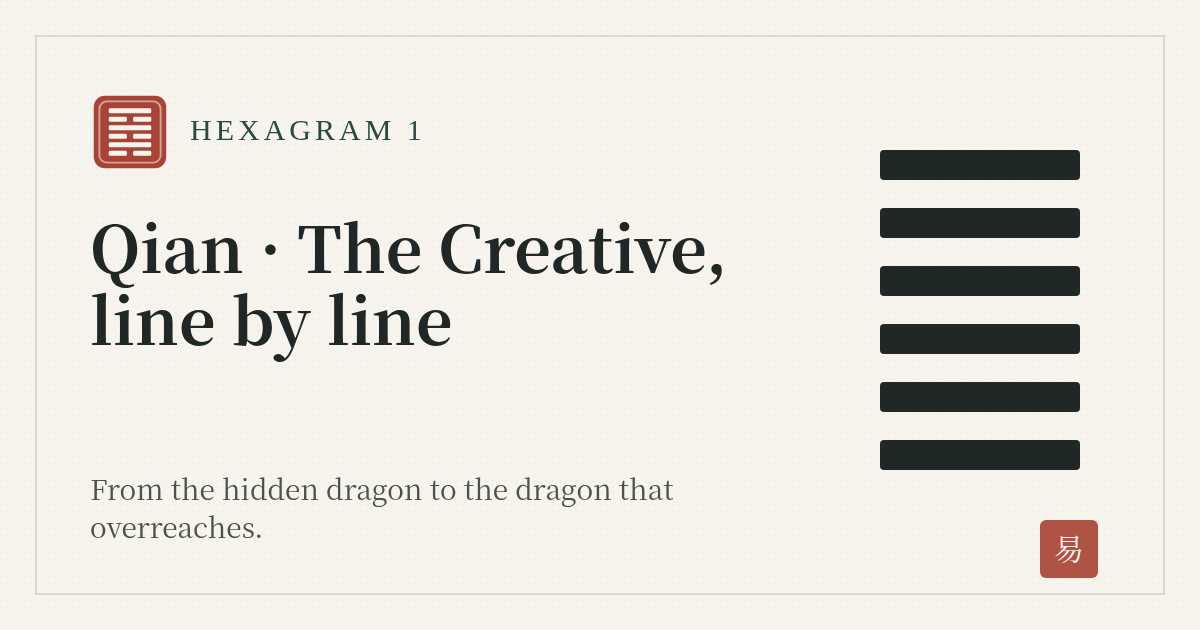
Hexagram 1, Qian (The Creative): Meaning and Every Line
A close reading of the first hexagram of the I Ching — the judgment, the image of heaven in motion, the six dragon lines from hidden to overreaching, and how to read Qian in love, work and decisions.
I Ching vs. Tarot: What Is Actually Different?
Both are used for reflection and guidance, but they work in very different ways. A clear comparison of origins, structure, randomness, text and the kind of answer each gives.